2-Strand Standard Yield
Splitting an 8m skein into three 2-ply ribbons provides 24 linear meters of working thread—completing roughly 1,650 crosses on 14ct, 1,850 on 16ct, or 2,100 on 18ct after tail waste.
Never cut cloth too narrow again. Use our precision 4-in-1 cross stitch calculator to convert stitch counts into exact inches and centimeters across 11ct to 36ct Aida, Evenweave, and Over-2 linen, add framing or hoop allowances, and estimate required 8-meter DMC floss skeins and tapestry needles instantly.
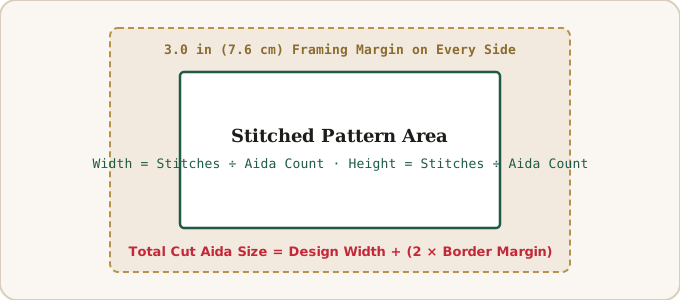
Every experienced stitcher remembers the heartbreak of spending forty hours on an heirloom sampler only to realize the stitched border stops half an inch from the raw frayed edge—leaving custom framers nowhere to tension or lace the cloth. Using a dedicated Aida fabric calculator inside our cross stitch calculator eliminates mental-math errors by separating finished design geometry from total cut yardage.
On woven Aida cloth, the count number tells you exactly how many grid squares sit inside one linear inch (`2.54 cm`). Dividing `140 stitches ÷ 14-count` yields a `10.0-inch` design width, where forgetting to double your `3-inch` framing border (`10 + 3 = 13"` instead of `10 + 6 = 16"`) leaves just `1.5 inches` per side. Our engine automatically doubles margins along both axes while converting imperial inches and European metric centimeters side by side.
Blunt-tip tapestry needles use an inverse wire gauge system: higher numbers (`#26` and `#28`) indicate slimmer shafts with narrower eyes that glide cleanly through fine weaves without stretching holes. Pair the cross stitch needle size chart below with your fabric selection above:
| Fabric Type | Effective St/In | Recommended Strands | Tapestry Needle | 100×100 Design Size |
|---|---|---|---|---|
| 11-Count Aida | 11 st/in (4.3 pts/cm) | 3 Full Strands | Size #22 or #24 | 9.1" × 9.1" (23.1 cm) |
| 14-Count Aida | 14 st/in (5.5 pts/cm) | 2 Full Strands | Size #24 Tapestry | 7.1" × 7.1" (18.1 cm) |
| 16-Count Aida | 16 st/in (6.3 pts/cm) | 2 Full Strands | Size #26 Tapestry | 6.3" × 6.3" (15.9 cm) |
| 18-Count Aida | 18 st/in (7.1 pts/cm) | 1 or 2 Strands | Size #26 or #28 | 5.6" × 5.6" (14.1 cm) |
| 28ct Linen (Over-2) | 14 st/in (equiv. 14ct) | 2 Full Strands | Size #26 Tapestry | 7.1" × 7.1" (18.1 cm) |
| 32ct Linen (Over-2) | 16 st/in (equiv. 16ct) | 2 Full Strands | Size #26 or #28 | 6.3" × 6.3" (15.9 cm) |
| 36ct Linen (Over-2) | 18 st/in (equiv. 18ct) | 1 or 2 Strands | Size #28 Petite | 5.6" × 5.6" (14.1 cm) |
Ordering every skein from the identical dye batch before starting a full-coverage landscape prevents subtle mid-sky color bands months later. Inside our built-in cross stitch floss calculator and skein calculator, thread consumption is modeled from physical 8-meter (`8.7-yard`) six-strand DMC cotton skeins:
Splitting an 8m skein into three 2-ply ribbons provides 24 linear meters of working thread—completing roughly 1,650 crosses on 14ct, 1,850 on 16ct, or 2,100 on 18ct after tail waste.
Holding three plies together on 11-count or dark 14-count cloth yields two 3-ply lengths (`16m` total), covering approximately 980 to 1,100 full crosses per skein.
Classic craft-aisle Aida tubes fit stitched areas up to 9" × 12" (`126 × 168 stitches` on 14ct) while preserving a full 3-inch framer border on all four edges.
Quarter-yard hand-dyed linen and Zweigart cuts accommodate designs up to 12" × 15" (`168 × 210 stitches` on 14ct or 28ct Over-2) with safe framing margins.
When you stitch Over-2 on 28-count Cashel or 32-count Belfast linen, finished dimensions match 14-count or 16-count cotton down to the millimeter, yet rounder flax fibers carry slightly deeper surface relief. Adding a 10% safety buffer to the skein estimate from this cross stitch calculator—and ticking off owned bobbins in our interactive 489 DMC color chart—ensures confetti jumps and loop starts never leave you twenty stitches short on a Sunday evening. Hosting a Stitch-Along or selling digital patterns? You can also embed this calculator on your own craft blog or shop with one line of zero-cookie HTML.
Before cutting artisan hand-dyed linen or raw unwashed cotton Aida, check the dyer's care tag for pre-shrunk treatment. Small-batch kettle-dyed fabrics have already relaxed in hot dye baths and rarely shrink further, whereas stiff starched mill-cut cotton can contract by roughly two to three percent along the warp during its post-stitching lukewarm wash. Zigzag-stitching raw edges on a sewing machine or applying narrow masking tape prevents Q-Snap clamps and scroll rods from fraying precious border inches during multi-month projects sized in this cross stitch calculator.
Convert artwork to DMC charts at the exact stitch width you calculated here.
🔤 Cross Stitch Font Generator →Test sampler alphabets and measure hoop fit on 14ct, 16ct, and 18ct cloth.
🧲 Free Cross Stitch Widget →Embed this responsive fabric and skein calculator on your craft blog or shop.
A standard 8-meter (8.7-yard) DMC 6-strand skein splits into three 2-strand working lengths totaling 24 meters of 2-ply thread. Accounting for diagonal back-side travel and normal needle tail waste, our skein calculator estimates roughly 1,650 full crosses per skein on 14-count Aida, 1,850 on 16-count, or 2,100 on 18-count cloth.
On Aida cloth, woven 4-thread clusters create clear corner holes so you stitch Over-1 block (`14 holes per inch`). On 28-count or 32-count linen and evenweave, individual warp and weft threads sit much closer together, so stitchers typically cross over 2 threads wide by 2 threads high—dividing the nominal count by two (`28 ÷ 2 = 14 stitches per inch`).
Acid-free foamboard pinning and traditional stainless lacing require enough clean unstitched linen to wrap smoothly around a `3/16-inch` mount board while keeping hoop creases completely hidden behind matboard bevels. Our cross stitch calculator defaults to 3.0 inches per side (`+6 inches` total width and height) so you buy safe cuts.
Switch from a standard #24 needle down to a slimmer #26 or #28 blunt tapestry needle when moving to 16-count or 18-count cloth. A thinner eye passes four overlapping corner threads cleanly without distorting neighboring grid squares.
A standard needlework Fat Quarter measures roughly `18 × 21 inches` (`45.7 × 53.3 cm`). Compare the Total Cut Fabric to Buy card in the cross stitch calculator against `18" × 21"`: if either dimension exceeds 18 inches, step up to a Fat Half (`21" × 36"`) or full yard.
Most relaxed hobbyists complete between 300 and 450 crosses per hour when working medium color blocks, or 180 to 250 crosses per hour in confetti-heavy portrait zones. Our estimator averages 380 stitches per hour to give realistic gift deadline expectations.